
How AI is Transforming Test Automation for Selenium Engineers
Introduction
I have been working with Selenium for a while now. You see, Selenium is a tool that helps us automate tests. Writing these tests is not that hard. Keeping them running smoothly is a big problem. If someone makes a change to the user interface, it can cause a lot of tests to fail. I spend a lot of time figuring out why my Selenium tests are not working right. This happens every day. The bigger the application gets, the more time I must spend on keeping my Selenium tests working properly.
When we are making something, we need to make sure it works properly. So manual testing of software, QA testing, and software test automation services are very important. They help us find problems with the product, especially when we are just starting out and trying to figure out if it's any good.
This is where AI is making a difference. It is helping in ways that make our work easier and more stable. AI is not replacing what Selenium engineers do. It is helping us work efficiently. Making our job easier.
The Shift from Script Writing to Smart Automation
Traditionally, Selenium automation has been very code-driven. We spend time:
- Writing locators manually
- Designing frameworks
- Debugging failures
- Updating scripts after UI changes
At the same time, teams continue to depend on manual QA testing for validation of complex user flows and edge scenarios. AI is now changing this workflow.
Instead of building everything from scratch, engineers can:
- Generate test scenarios from requirements
- Get smarter locator suggestions
- Identify edge cases quickly
It is not about taking away the coding; it is about making the work easier by doing fewer things repeatedly. The main goal is to reduce the work that coders do.
Self-Healing Scripts: Less Maintenance, More Stability
One of the biggest challenges in Selenium is handling UI changes. A small update in the DOM can break multiple tests, especially in large regression testing services where full suites run regularly. AI-powered tools solve this using self-healing capabilities.
What changes:
- AI detects locator failures
- Finds alternative attributes
- Updates scripts automatically
Benefits:
- Fewer false failures
- Stable regression runs
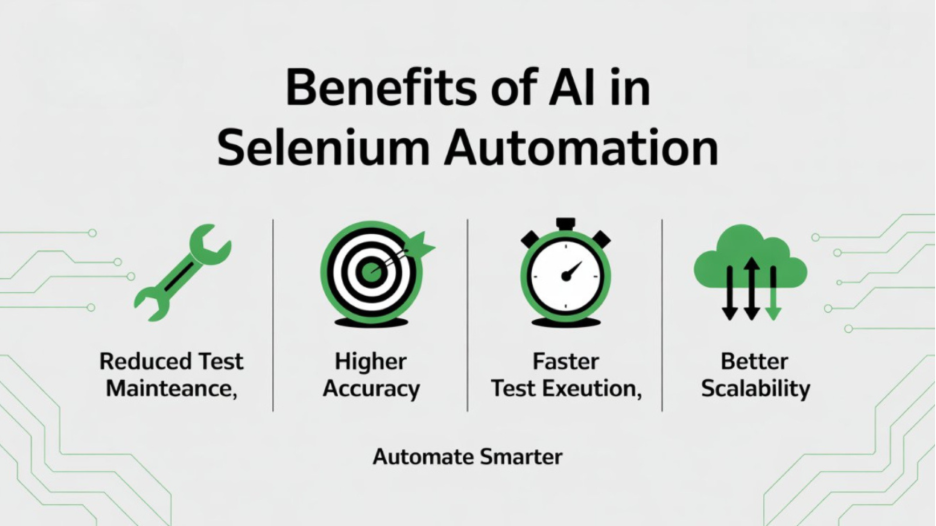
- Reduced maintenance overhead
This improves both automation and regression testing services, making them faster and more reliable.

AI-Assisted Test Case Creation
Creating test cases manually takes a lot of time. When we talk about software testing or automation, creating test cases manually is a time-consuming task.
AI now helps by:
- Reading Jira tickets or requirements
- Understanding expected behaviour
- Generating test scenarios instantly
Instead of starting from scratch, you can:
- Use AI as a base
- Refine the generated test cases
- Focus on business logic
This is especially useful when working with tight deadlines and large applications.
Smarter Test Execution with AI
Traditionally, teams run the full regression suite for every release. In most regression testing services, this leads to:
- Long execution times
- Unnecessary tests running
- Delays in CI/CD pipelines
AI improves this by:
- Analysing code changes
- Selecting relevant tests
- Prioritising high-risk areas
Result:
- Faster builds
- Efficient pipelines
- Better coverage with less effort
Better Debugging and Failure Analysis
Debugging Selenium failures is really time-consuming. It takes a lot of time to figure out what went wrong. Even engineers must spend hours looking at logs and screenshots to find out the problem. They have to go through all the details to understand what caused the failures. This is because Selenium failures can be tricky to fix.
AI improves this by:
- Identifying failure points quickly
- Highlighting the root cause
- Suggesting fixes
This makes it easier to find problems. Helps teams work faster. It is really helpful when teams are doing both automated testing and manual testing at the same time. Testing cycles can be time-consuming, so this really helps with automation testing and manual QA testing cycles.
AI + Selenium Integration
AI is not replacing Selenium it is working alongside it.
Modern tools:
- Generate Selenium-ready code
- Integrate with existing frameworks
- Complement software manual testing efforts
This allows teams to:
- Keep existing setups
- Improve efficiency
- Gradually adopt AI
Challenges to Keep in Mind
AI is powerful, but not perfect.
Things to consider:
- AI-generated scripts still need validation
- Incorrect element mapping can occur
- Human understanding is still important
Manual testing, especially manual software testing services, remains critical for:
- Exploratory testing
- Usability validation
- Business logic verification
What This Means for Selenium Engineers
AI is not a threat it is an opportunity. As a Selenium engineer,
You should:
- Learn AI-based testing tools
- Understand self-healing concepts
- Combine automation with manual strategies
- Leverage AI for productivity
The role is evolving from Script Writer to Smart Quality Engineer
Conclusion
AI is transforming how Selenium engineers approach test automation. It reduces maintenance, improves stability, and speeds up test creation. At the same time, software manual testing, AI testing services, and structured regression testing services continue to support overall quality. The future of testing is not just automation; it is a combination of:
- AI-driven intelligence
- Strong automation practices
- Human validation through manual QA
Teams that get all three rights will deliver software faster and more reliably. Making software that's good, fast, and dependable.