
How AI Is Changing API Testing: From Scripted to Self-Healing Tests
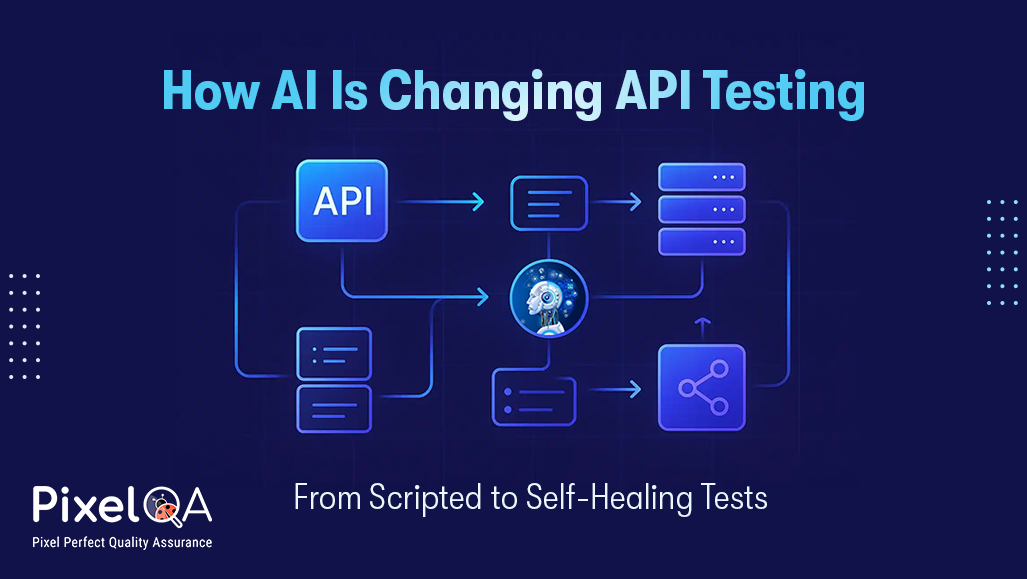
Table of Contents
Introduction
Across many projects, one thing keeps showing up: traditional API testing is more fragile than it looks. Small changes can break multiple tests, delay releases, and add extra work for teams.
With businesses now expecting greater stability and the rise of software api testing services, AI is stepping in to transform how testing is done. Instead of replacing testers, AI takes over repetitive, brittle tasks, making test suites smarter, faster, and more resilient.
Here’s how this transformation is unfolding:
The Hidden Cost of Scripted API Tests
Teams relying on traditional testing methods often encounter the same challenges:
- Fragile test suites: Minor API changes break multiple tests.
- High maintenance effort: QA teams spend hours fixing or rewriting scripts.
- Limited coverage: Human-written tests often miss complex or rare edge cases.
- Slow debugging: Determining why tests fail can take a lot of time and slow down the entire team.
That’s why many businesses collaborate with trusted QA partners like an API Testing Company or dedicated quality assurance experts to boost stability and improve delivery speed.

What AI Actually Changes
AI doesn’t replace testing; it elevates it.
Here’s how:
1. Automated Test Generation
AI can read API documentation, contracts, logs, and traffic patterns to automatically generate meaningful test cases, including edge scenarios. This works well for both internal QA teams and companies implementing API testing automation.
2. Self-Healing Test Suites
When your API evolves, AI automatically updates test scripts to reflect the new structure. This dramatically reduces maintenance for both in-house QA teams and external testing partners.
3. Intelligent Assertions with Context
Instead of relying on brittle exact matches, AI understands patterns, valid ranges, and natural variations, resulting in fewer false positives and more reliable pipelines.
4. Predictive Testing
AI uses historical data to identify high-risk components in your API and prioritizes testing there, enabling faster detection of real issues.
5. Smarter Test Data & Environment Awareness
AI generates realistic test data, anonymizes sensitive fields, and adapts to differences across environments. This significantly reduces setup overhead for QA teams and partners.
Read More
Discover how API testing with RestAssured simplifies automation, improves test accuracy, and ensures reliable backend performance across applications.
API Testing with RestAssured: Complete Guide
Why This Matters for Your Business
Whether you're working with an external API Testing Company or running your own in-house QA team, AI-driven API testing delivers substantial benefits:
- Faster release cycles
- Broader test coverage
- Reduced flakiness and maintenance
- More predictable and stable deployments
- Better customer experience
This change helps organizations improve API reliability without growing their QA team.
Important Considerations Before Adopting AI
AI can make a huge difference in how API testing is done, but it really shines when teams define the right boundaries, add the right protections, and keep an eye on how it’s being used:
- Sensitive data should be masked
- AI models need regular tuning as systems evolve
- Teams must shift from writing scripts to focusing on strategy and supervision
These considerations apply whether your QA efforts are internal or supported by a trusted testing partner.
Conclusion
AI gives API testing a big boost in speed and intelligence. It takes over the work that slows teams down, finds problems early, and keeps projects on track. But to get the most out of AI, you still need solid expertise and the proper tools supporting it.
That is where a reliable API Testing Company makes all the difference. With the right partner, your APIs get tested thoroughly using trusted frameworks and modern AI-powered practices that help keep your systems stable and your users happy.
Contact PixelQA Today to strengthen your API testing strategy and deliver more stable, reliable software with confidence.
About Author

Jagdish Chavare is a software tester with 2+ years of experience in manual and automated testing using Playwright, API testing with Postman, and SQL database testing. He ensures software is reliable, functional, and data-accurate.