
How AI Helps in Bug Prediction and Defect Analysis
Introduction
In the software industry things are moving fast. One of the problems that QA teams face is getting good software out quickly. Software applications are getting bigger and more complicated. This means they are more likely to have defects and fail. The old ways of testing still work. They are not enough to test complex software applications by themselves. QA teams need to do something because manual testing is not enough to manage complex applications, like these software applications efficiently.
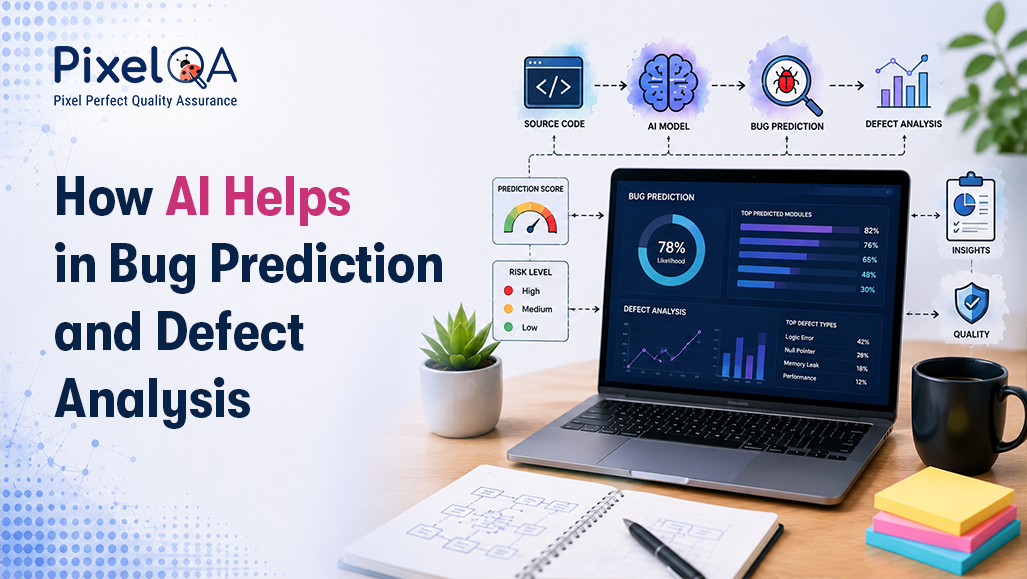
Artificial Intelligence is changing the way we do Software Testing Services by making testing smarter and faster. One of the uses of AI in testing is predicting bugs and analyzing defects. AI helps teams find parts in applications that may contain issues, and it also predicts defects before software is released, which improves software quality. AI-powered Software Testing Services help teams identify important areas in applications and support better testing before release. Instead of only finding bugs after failures occur, AI systems can analyze historical defects, testing reports, user behavior, and application workflows to predict where issues are most likely to happen.

What is Bug Prediction and Defect Analysis?
Bug Prediction is the process where AI systems analyze software data and identify which modules or features are more likely to contain defects. Defect Analysis helps teams understand why bugs occur and identify patterns in software failures.
AI tools study different types of application data such as:
- Historical defects
- Failed test cases
- Application workflows
- Code changes
- User behavior
- Test execution reports
- Performance logs
- API responses
AI systems can look at the information. Find the parts of the application that are likely to have problems. This helps the testing teams focus on the modules that're likely to fail. That way they do not miss problems when they are testing.
For example, if the payment module has a lot of problems after every new version is released the AI tools can see that the payment module is risk. The AI tools will then say that the payment module needs to be tested. Similarly, if specific workflows repeatedly produce bugs, AI systems can notify QA teams before production release.
Defect Analysis also helps teams identify the root causes of failures. Instead of only fixing bugs, QA teams can understand why defects happen repeatedly and take preventive actions to improve software stability.

How AI Predicts Software Bugs
AI systems use Machine Learning algorithms to study patterns from previous defects and testing activities. These systems continuously learn from application behavior and improve prediction accuracy over time.
AI can identify:
- Frequently failing modules
- Repeated defects
- High-risk workflows
- Unstable automation scripts
- Performance-related failures
- Areas affected by recent code changes
- Risky APIs and backend services
Instead of testing every module equally, AI helps QA engineers prioritize testing based on risk level. This improves testing efficiency and reduces unnecessary testing effort.
For example, if developers make changes in the login or payment module and previous releases already had multiple defects related to those areas, AI can mark them as highly risky for the next release. QA teams can then perform additional testing on those modules before deployment.
AI tools also monitor testing history and defect frequency. If a specific feature repeatedly fails after deployment, the system automatically increases the risk score for that feature in future releases. This helps teams identify unstable modules early.
Another important thing that AI can do is recognize patterns. AI systems can look at large amounts of test results very quickly and find patterns that are hard for people to identify manually. This helps the testing teams make defect analysis better and make decisions about testing. The AI systems can look at thousands of test results in a few seconds. This makes the whole testing process go faster. It becomes more efficient for the testing teams. The testing teams can then use the AI systems to improve the defect analysis and make testing decisions.

How AI Helps QA Teams
AI makes software testing better by making it smarter and more efficient. One big advantage is that it reduces a lot of manual work. Earlier, humans used to spend a lot of time checking defect reports while testing software. Now, AI systems can automatically find problem areas and give recommendations, which helps get the job done quicker. AI improves software testing and makes the whole testing process more efficient.
AI helps QA teams by:
- Identifying risky application modules
- Predicting possible production defects
- Prioritizing test execution
- Improving regression testing
- Reducing manual analysis effort
- Improving test coverage
- Detecting hidden edge cases
Artificial intelligence also helps developers and quality assurance teams work together better. Developers can find the code areas that're not stable sooner and quality assurance teams can focus on the testing activities that are very important.
Another major benefit is intelligent automation. Traditional automation scripts often fail when UI elements change. AI-powered automation tools support self-healing automation, where the system automatically updates locators and reduces automation failures.
This significantly improves automation stability and reduces script maintenance effort.
Benefits of AI in Bug Prediction and Defect Analysis
Faster Defect Identification
AI tools can analyze large amounts of testing data very quickly, helping QA teams identify possible defects faster than traditional testing methods.
Better Test Coverage
AI identifies hidden edge cases and risky scenarios that manual testing may miss. This improves software reliability and reduces production issues.
Reduced Manual Effort
QA engineers spend less time analyzing reports manually because AI automatically identifies patterns and risky areas.
Improved Software Quality
By predicting defects before production release, AI helps improve software stability and user experience.
Smart Decision Making
AI provides useful insights and analytics that help teams decide where additional testing is required.
Faster Release Cycles
AI helps teams complete testing activities more efficiently, which supports faster software delivery and CI/CD workflows.
Improved Regression Testing
AI can automatically prioritize important regression test cases based on recent code changes and historical defect data.
Real-Time Use Cases of AI in Testing
Many organizations are already using AI-powered testing tools for bug prediction and defect analysis. AI is helping companies reduce production failures and improve testing efficiency.
Some real-world examples include:
- Predicting payment failures in e-commerce applications
- Identifying crash-prone screens in mobile applications
- Detecting unstable APIs before production release
- Finding risky workflows in banking applications
- Predicting performance bottlenecks in web applications
- Identifying areas affected by backend database changes
Large organizations use AI tools to analyze thousands of testing results and identify possible release risks automatically. This helps companies improve customer experience and reduce software downtime.
For example, AI systems in e-commerce platforms can identify checkout modules that are likely to fail during high traffic periods. QA teams can then perform additional testing before major sales events.
Popular AI Testing Tools
Many organizations are using AI-powered testing tools to improve software quality and testing efficiency. Some popular tools include:
- Testim
- Applitools
- Mabl
- Functionize
- ACCELQ
- Katalon AI
- Selenium with AI integrations
- ChatGPT for test generation and defect analysis
These tools help automate:
- Test case generation
- Regression testing
- Visual validation
- Defect prediction
- Automation maintenance
- Test reporting and analytics
AI testing platforms improve overall testing efficiency and help teams execute larger regression suites within shorter durations.

Challenges of AI in Defect Analysis
Although AI offers many benefits, there are still some challenges in implementation. AI systems require high quality historical data for accurate predictions. If application data is incomplete or inaccurate, prediction quality may decrease.
Some AI testing tools also require additional setup, training, and integration effort. Enterprise AI platforms can sometimes be expensive for small organizations.
Other common challenges include:
- Initial learning curve for teams
- Integration with legacy applications
- Dependency on historical defect data
- Prediction accuracy limitations
- Maintenance of AI training models
Despite these challenges, AI adoption in software testing is growing rapidly because of its long-term efficiency and productivity benefits.
Future of AI in Software Testing
The future of software testing is really changing because of Artificial Intelligence and Machine Learning. Artificial Intelligence is a help to QA teams. It helps them automate tasks that they have to do over and again. This makes testing more accurate. Reduces problems that people have when they use software. Software testing is getting smarter, with the help of Artificial Intelligence and Machine Learning. Artificial Intelligence and Machine Learning are making software testing better.
In the future, AI may help with:
- Fully automated test generation
- Self-healing automation frameworks
- Automatic defect fixing suggestions
- Real-time application monitoring
- Predictive analytics for releases
- Smart API testing
- Intelligent performance testing
As companies keep using DevOps and CI/CD practices Artificial Intelligence will become a part of how we test software these days.
Artificial Intelligence may not totally replace people who do testing but it will keep helping Quality Assurance teams do their job better and make sure the software is really good.

Conclusion
Artificial Intelligence is really changing the way we test software. It is making Bug Prediction and Defect Analysis a lot better. Now we do not have to wait for something to go wrong to find bugs. Artificial Intelligence helps teams figure out which parts of the software are likely to have problems before we release it. This means we can focus our testing on the things and do a better job.
AI-powered testing tools are really helpful for QA teams because they reduce a lot of manual work and help teams deliver applications faster. These tools also help organizations find defects that are not easy to identify manually by analyzing previous issues and supporting better testing decisions. As part of modern Automation Testing Services, AI-powered testing tools improve efficiency, accuracy, and test coverage across complex applications. This makes AI-powered testing tools very useful for both QA teams and organizations.
Artificial Intelligence is not going to take the place of testers on its own. Artificial Intelligence really does help testers do their work faster and it makes testers more efficient. As software applications become more complicated, Artificial Intelligence plays an important role in testing and helps make sure the software quality is good. It also helps improve the overall Software Testing process and supports testers in many different ways.