
Future Trends Every Tester Should Watch: AI Vs Humans
Table of Contents
- Self Healing Test Automation
- Intelligent Test Case Generation
- Data Driven Test Coverage Optimization
- Protecting Sensitive Customer Data
- AI Powered Visual Validation
- Predictive Defect Identification
- Smarter Continuous Testing in CI/CD Pipelines
- Natural Language Testing
- The Evolving Role of Testers
- Final Thoughts
Automation testing has come a long way. Earlier was a simple script execution has now evolved into autonomous systems that can learn, adapt, and even make decisions it self. Artificial Intelligence (AI) is no longer meaningless in a testing; it is gradually transforming how quality assurance teams work and think. This is also where ai based software testing helps teams validate risk before release.
As applications grow more complicated, classical forms of automation are seldom sufficient. This is when the role of AI is not to substitute testers but to provide an aid that makes testing more intelligent, quicker, and more operational. Presently, numerous software testing companies, along with nearly all ascending QA companies, are in a state of examining AI powered solutions to remain competitive and to provide enhanced quality at scale.
Let’s explore the future trends of AI in test automation and what they mean for testers and organizations alike.
1. Self Healing Test Automation
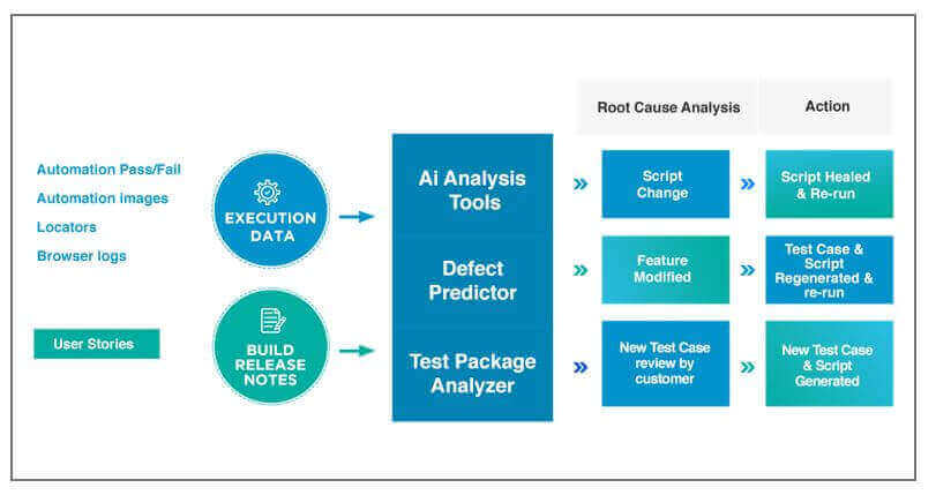
Test automation can be a hassle when it comes to maintenance. The thing is, a tiny change, to the user interface like renaming something or moving things around can make a lot of tests stop working. Test automation is a job and it needs constant maintenance.
AI-powered self healing mechanisms can automatically detect such changes and adjust test scripts based on patterns and historical executions. This reduces test failures caused by minor application changes.
Why it matters:
- Less time take to fixing broken scripts
- More stable automation suites
- Higher trust in automation results
This is especially valuable for any QA automation testing company managing large and frequently changing applications.
2. Intelligent Test Case Generation
Creating large test cases manually takes time and effort. AI can assist by analyzing requirements, user stories, system logs, and user behavior to generate relevant test scenarios.
Instead of starting from scratch, testers can work with:
- AI-suggested test scenarios
- Coverage based on real user flows
- Automatically identified edge cases
For growing testing teams within a QA company, this significantly improves productivity and consistency across projects.
3. Data Driven Test Coverage Optimization
AI uses real application data to identify high risk and high usage areas. By analyzing production analytics and historical defect trends, it helps teams prioritize the most important test cases.
This allows software testing firms to focus on where failures are most likely to occur, rather than spreading time evenly across low risk areas like updating cases
Result:
Smarter testing, better coverage, and faster releases.

4. AI Powered Visual Validation
Functional tests alone are no longer sufficient for modern UI heavy applications. AI based visual testing compares screens intelligently, detecting real visual issues like broken layouts, misaligned elements, or missing components.
Unlike traditional pixel by pixel comparisons, AI understands context recognizing which visual changes are acceptable and which indicate defects.
This capability is fast becoming standard practice for every serious QA automation testing company aiming to reduce manual UI checks.

5. Predictive Defect Identification
AI can analyze patterns from previous releases, code changes, and defect histories to predict potential failure prone areas.
This enables teams to:
- Focus testing on high risk modules
- Identify issues earlier in the development cycle
- Improve release confidence
Many leading software testing firms are already leveraging predictive analytics to shift testing from reactive to proactive.
6. Smarter Continuous Testing in CI/CD Pipelines
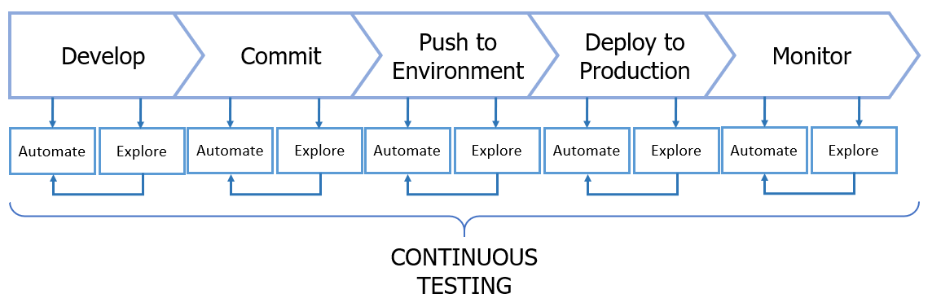
Smart CI/CD Test Execution Advanced CI/CD pipelines require speed, while running the full test suite for every build is not practical. AI can assist in optimizing test execution by running only the relevant tests for the changed code. This helps maintain continuous testing speed, without compromising quality, an essential for any scalable QA company in agile or DevOps environments.
7. Natural Language Testing
Natural Language Driven Testing AI and natural language processing help to develop test cases in user friendly language and turn them into executable tests. This helps business stakeholders, testers, and developers to work together and keeps automation collaboration simple. For testing as a service organizations, this improves onboarding and interactions with clients.
8. The Evolving Role of Testers
Testers' roles are enhanced, not replaced, by AI. Rather than working on repetitive tasks, testers should focus on:
- Exploratory testing
- Risk analysis
- Test strategy design
- Understanding real user behavior
The human ability to think critically and creatively remains irreplaceable, even in the most advanced QA automation testing company.
Final Thoughts
AI is transforming software test automation services from a rule based activity into an intelligent quality assurance practice. Forward looking software testing firms and QA companies are adopting these advancements not just to automate faster, but to test smarter and deliver product earlier.
The future of testing mostly depends on AI and Human in that AI handle time, complexity and scale, while humans handle judgment and empathy for clients
Testing is not losing its human touch, it is change with better tools.